
Why Using Civilians as Bargaining Chips in War is Wrong
Trump is essentially holding the lives of 90 million Iranian civilians hostage to coerce the Iranian government into opening the Strait.

In the lead-up to the Gulf War Iraqi dictator Saddam Hussein detained over 800 Western, Japanese and Kuwaiti nationals and placed them at strategic military and industrial sites in Iraq to deter a looming U.S.-led attack. The world responded with outrage, calling Saddam’s ‘human shield’ ploy a blatant violation of the 1949 Geneva Conventions.
Saddam tried to fight the bad publicity with a staged propaganda stunt with his “guests”. But this backfired when the world saw Saddam patting a clearly nervous 5-year old British national (Stuart Lockwood) on the head and asking him if he was getting his milk. Sensing that he was facing a public relations disaster, Saddam eventually released his hostages before the war got under way in earnest.
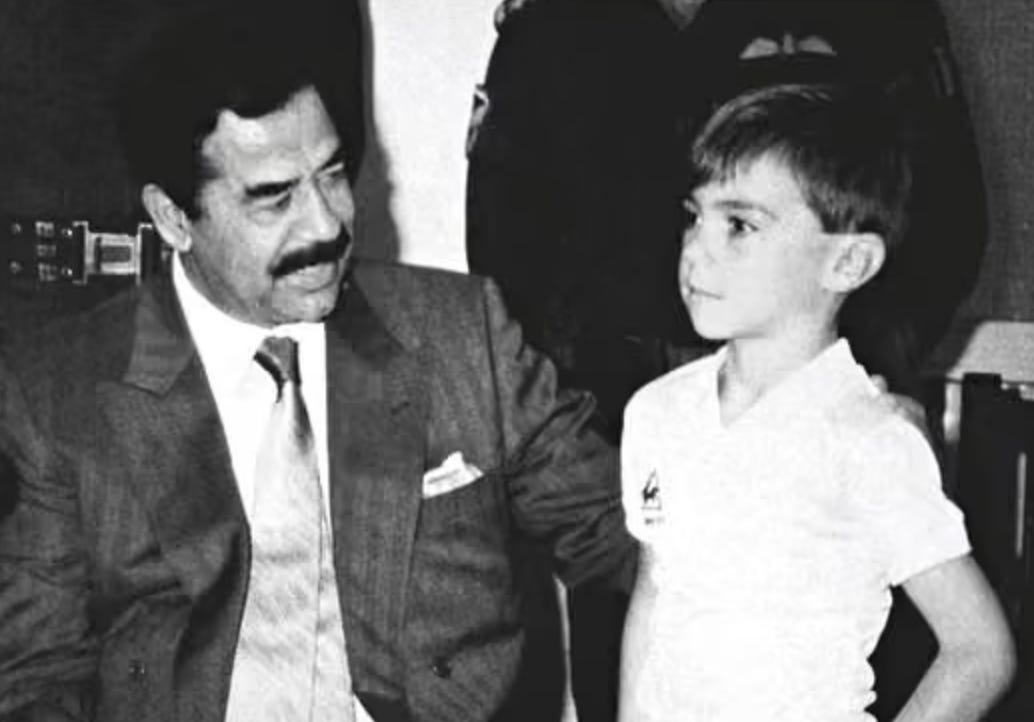
The world was repulsed because Saddam was cynically attempting to exploit unarmed civilians, in violation of their rights and international law, to give him an advantage in a military conflict. This galled the West in particular, since it had emerged from the First and Second World Wars with a set of international laws that sought to prevent such acts. According to this corpus, primarily the Geneva Conventions, Saddam had crossed the line into illegality.
Fast forward more than 35 years later and it’s now an American president who is threatening to illegally use civilians to shape a military conflict. But Trump in 2026 is not seeking to use Iranian civilians as shields but rather as targets by targeting the infrastructure that sustains civilian life–a direct violation of the Geneva Conventions (Additional Protocol I, 1977).
Specifically, the Conventions require that civilian and military objects be clearly distinguished (Article 48); civilian objects shall not be the object of attack (Article 52); and they prohibit destroying the infrastructure necessary for the survival of the civilian population, such as water and food sources (Article 54). Most compelling for the case of Iran is Article 57 which prohibits attacks where the expected civilian harm is excessive compared to the direct military advantage of doing so (the principle of proportionality).
While the U.S. did not ratify the Geneva Convention’s Additional Protocol I, it is still considered customary international law, which is binding on all nations. Furthermore, when it comes to targeting possible dual-use civilian infrastructure, the Department of Defense’s Law of War Manual endorses the principle of proportionality; again, that is the expected military gain of attacking civilian infrastructure must outweigh the anticipated harm to civilians. The benefit of the doubt is always given to civilians: where there is any ambiguity the infrastructure in question is deemed civilian and therefore out of bounds for targeting purposes.
The same manual prohibits threats of violence where the primary purpose is to spread terror among civilians (which is akin to terrorism). The deliberate bombing of hospitals, schools and markets was part of the reason (in addition to chemical weapons use and mass detainment, torture and execution) that the U.S. attempted to hold Syrian dictator Bashar al-Assad and several key members of his regime responsible for war crimes and crimes against humanity.
Trump entered this war under the mistaken premise that Israeli decapitation strikes on Iranian regime leadership would cause the regime to quickly collapse. When that didn’t happen the two continued bombing in the hope that it would eventually topple the regime. When this did not happen and Iran seized the Strait of Hormuz, effectively taking the entire world economic hostage, Trump floundered, on one hand proclaiming victory and seeking negotiations, on the other calling on other powers to re-open the Strait. When this fell flat, in a seeming act of desperation, he resorted to threatening to destroy Iranian civilian infrastructure, power plants, bridges, oil facilities, even desalination plants.
Trump’s threats threaten all Iranians, but they threaten civilians more than the regime, since the regime will be the first in line to receive what little civilian goods remain when Trump makes good on his promise to destroy the country.
Such an act would clearly be a violation of the Geneva Conventions since it would target facilities that primarily serve civilian functions. Most importantly, a large-scale attack on Iranian civilian infrastructure, which would undoubtedly cause widespread power outages, economic dislocation, food and water shortages and public health and sanitation crises would be a totally disproportionate response to the military objectives of the war (on which Trump and his administration still seem to be a little hazy).
Trump is essentially holding the lives and livelihood of around 90 million Iranian civilians hostage to coerce the Iranian government into opening the Strait. But even more cynically, he is doing this to extricate himself from a war of choice that he and his administration badly misjudged by arrogantly thinking that it would be quick and easy.
Now, because he doesn’t want to be bothered with a long war, with the worst oil crisis in modern history, with sending in U.S. ground troops (the only way to truly guarantee the collapse of the regime and assure that Iran does not gain nuclear weapons) Trump is threatening to bomb millions of Iranian civilians “back to the stone age”. If this isn’t a war crime than what is?
When asked by a reporter Trump dismissed the war crimes issue, saying that he was “not at all” concerned about it. And now he has gone even further, saying that Iran’s “whole civilization will die tonight” if a deal on opening up the Strait is not reached.
The intent here is clear: after threatening the Iranian people with genocide, Trump reminds the regime that he is open to a deal by saying: “…now that we have Complete and Total Regime Change, where different, smarter, and less radicalized minds prevail, maybe something revolutionary wonderful [sic] can happen, WHO KNOWS?”
We know one thing: Destroying an entire civilization, as Trump now proposes, would be an act of genocide. I’m thankful that, as a civilian, I don’t have the weight of the president’s words on my shoulders. And I don’t have to contemplate–as commanders, airmen and those drawing up the target packages do–the moral implications of my actions.
But we all have a responsibility to speak out in the face of immoral acts and injustice. Especially those that would so badly stain America’s honor. Destroying Iran’s civilian infrastructure would be immoral and, by any stretch of the imagination, a war crime. History is watching and will judge us all.
AVDD’s sole purpose is to fight for democracy and freedom, in America and throughout the world. But we need your support! If you enjoy AVDD’s content, please help us stay in the fight by subscribing to this Substack page, or consider a monetary donation. Thank you!!
'Why terrorism is wrong' would be an alternative headline